
Multi-Station Manifold Blocks Manufacturer
One block. Multiple cylinders. Total synchronized control. We manufacture single monolithic valve bodies housing 2 to 10 directional control valves in a shared P and T gallery circuit for complex Special Purpose Machines.
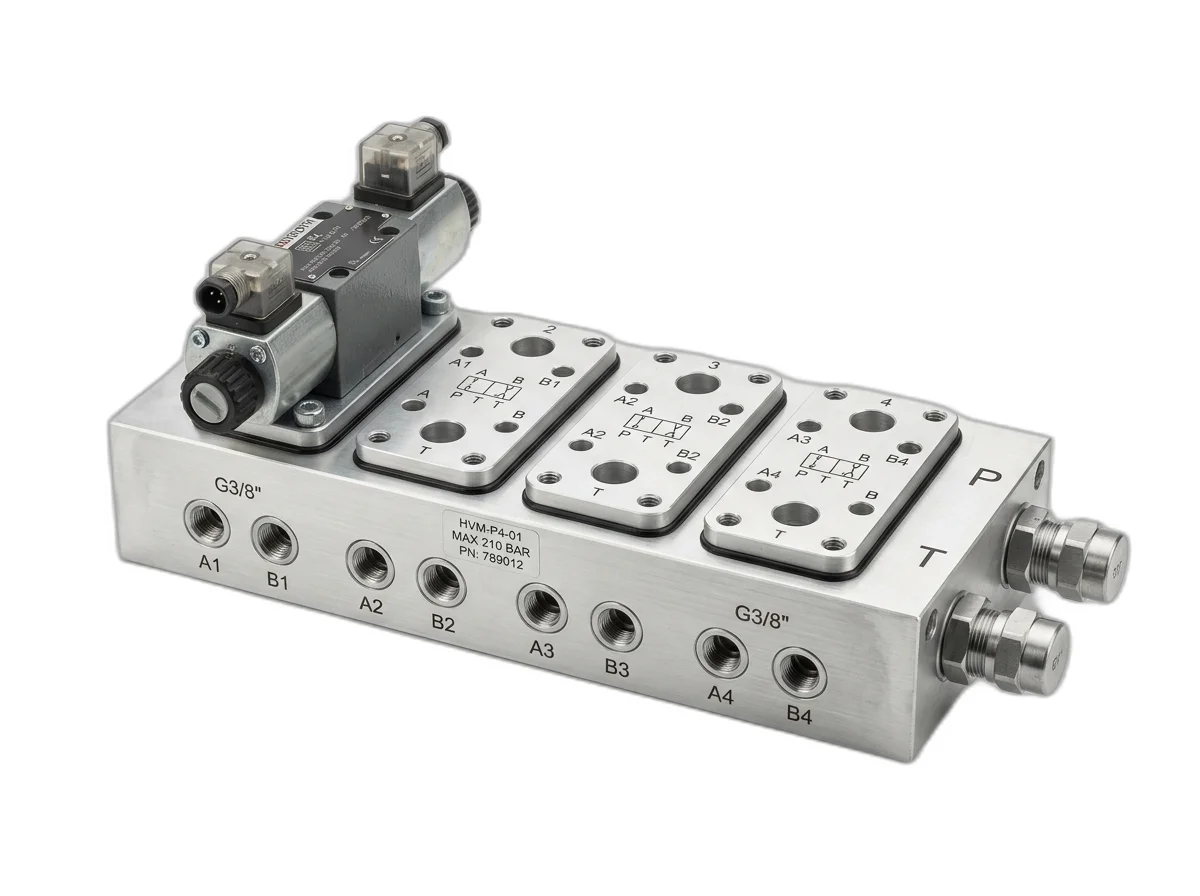
What Is a Multi-Station Manifold Block?
A multi-station manifold block (also called a parallel manifold rail or gang block) is a single elongated block of machined metal that accommodates multiple directional control valves — each valve occupying one "station" on the block's top face.
Internally, the block contains two shared longitudinal galleries running the full length of the block:
- The P Gallery: Connects to the hydraulic power pack and distributes system pressure to all valve stations simultaneously.
- The T Gallery: Collects the return oil from all valve stations and routes it back to the tank.
Each valve station has its own independent A and B work port pair exiting the block body, allowing each valve to control an independent actuator. This architecture allows one power pack to serve multiple cylinders from a single, centralized, completely leak-proof block.
Integrated Safety Features
Multi-station blocks can incorporate optional integrated safety logic, eliminating additional external valve installations.
Individual Station Relief Valves
Per-station pressure relief cartridges machined directly into the block body, allowing different circuit areas to operate at different pressures from a single power pack.
Pilot-Operated Check Valves (POCVs)
Integrated directly at each A/B work port to provide load-holding capability for vertical cylinders or clamping applications.
Gauge Ports
G1/4" pressure gauge tapping points at each station for commissioning and diagnostic purposes.
Manual Override Provisions
Threaded override bores allow technicians to manually shift a stuck solenoid valve during maintenance without disassembling the hydraulic circuit.
Technical Specifications
Detailed specifications for our multi-station manifold blocks.
Capabilities
| Parameter | Value |
|---|---|
| Station Range | 2-Station to 10-Station (custom counts on request) |
| CETOP Sizes | CETOP 3, CETOP 5, CETOP 7, CETOP 8 |
| Material | Aluminium 6061-T6 (≤210 Bar), ST52 Steel (≤315 Bar) |
| Circuit Configuration | Parallel, Series, or Mixed (custom) |
| Optional Integrations | Per-station relief, POCVs, gauge ports, manual overrides |
| Surface Treatment | Anodize (Al), Zinc Plate or Black Oxide (Steel) |
| Lead Time | 2–4 weeks (standard), 1 week (repeat orders) |
| Testing | 100% hydrostatic at 1.5x working pressure |
Parallel vs. Series Circuit Configuration
The internal gallery design dictates the operational logic of the multi-station block. The majority of industrial SPM applications use parallel centre configuration, allowing any valve to be operated independently or simultaneously.
| Circuit Type | Parallel | Series | Tandem Centre |
|---|---|---|---|
| P Gallery Design | Single shared P gallery feeds all stations simultaneously | Outlet of station 1 feeds inlet of station 2, etc. | Shared P and T with tandem spool valves for low-idle pressure |
| T Gallery Design | Single shared T gallery | Single shared T return | Standard T |
| Typical Use Case | Independent control of multiple cylinders (most common) | Synchronized sequence — cylinder A MUST complete before cylinder B starts | High-speed press with energy-efficient idle state |
Station Count Selection Guide
Selecting the correct number of stations is determined by the number of independent actuators in your circuit. Our engineers will analyse your hydraulic schematic and recommend the optimal station count.
| Station Count | Typical Machine Type | Cylinder Requirement |
|---|---|---|
| 2-Station | Simple clamping + pressing machine | 2 independent cylinders or motors |
| 4-Station | Injection moulding core-pull systems | Clamping + injection + core-pull A + core-pull B |
| 6-Station | Multi-clamp SPM fixtures | 6 independent work-holding clamps |
| 8-Station | Transfer press automation | 8 sequential pressing/punching cylinders |
| 10-Station | Complex assembly automation | 10-axis SPM with full simultaneous logic |
CETOP Size Options
CETOP 3CETOP 3 (NG6) Multi-Station
Ideal for compact SPMs with cylinder bores up to 80mm and flow rates up to 40 LPM per station.
CETOP 5CETOP 5 (NG10) Multi-Station
The most common size for general industrial automation up to 120 LPM per station.
CETOP 7CETOP 7 (NG16) Multi-Station
For high-flow circuits powering large-bore cylinders and hydraulic motors at up to 250 LPM per station.
CETOP 8CETOP 8 (NG22) Multi-Station
For very high-flow systems driving massive press cylinders at 400+ LPM per station.
8-Station CETOP 5 Manifold Block for Automotive Welding SPM
Tier-2 Automotive Supplier — Changodar GIDC, Ahmedabad
The Challenge
The Solution
The Outcome
Related Products
Explore our complete range of hydraulic manifold and logic block solutions.
Browse all products →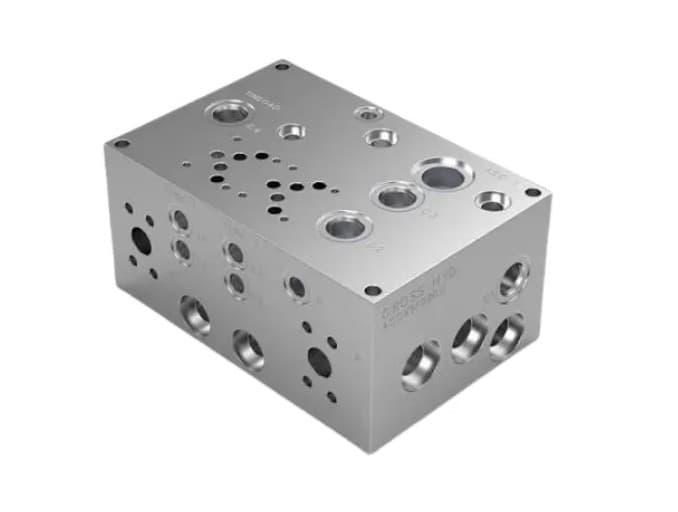
Custom Manifold Blocks
Fully integrated logic blocks with internal cartridge valves for zero-leak automation.
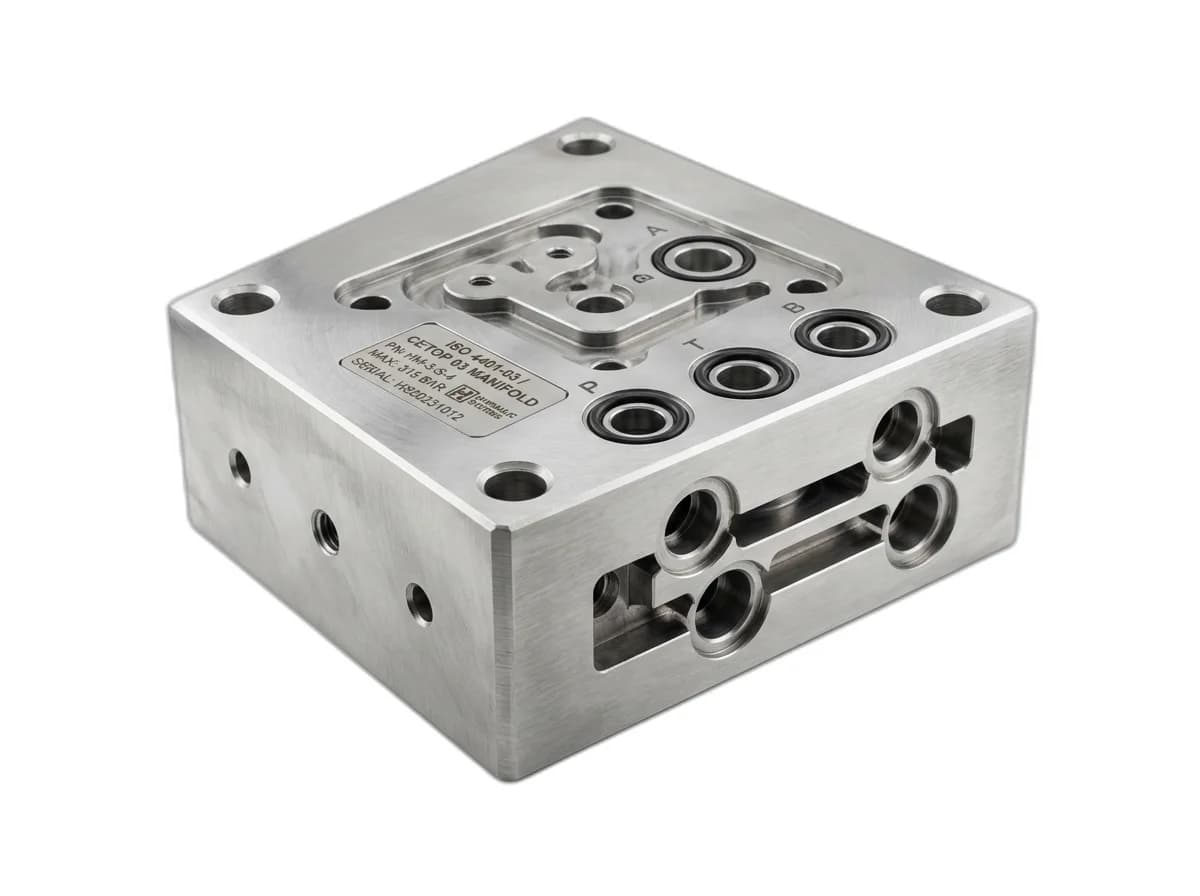
CETOP Subplates
Standard mounting plates for NG6 and NG10 directional control valves.
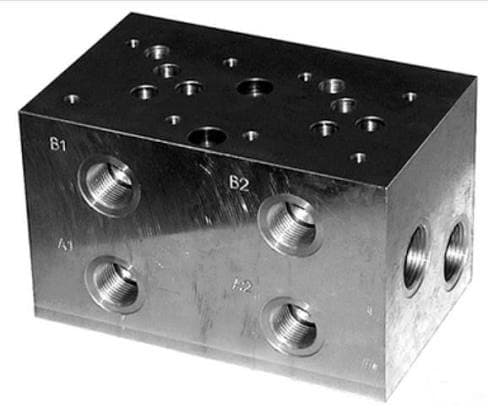
10-Size Manifold Blocks
High-flow NG16 CETOP 7 subplates for heavy industrial machinery.
Proven Performance on the Factory Floor
Read direct feedback from plant managers, machine builders, and OEM procurement teams across India who run Honeywell Multi-Station Manifold Blocks in high-duty operations.
“The 6-station parallel CETOP 3 manifold rail consolidated all solenoid valves for our packaging line into a 450mm footprint. Clean gun-drilled pressure galleries with zero pressure differential between stations.”
Mr Ketan Patel
Automation Systems Engineer, Creative Automation
Order feedback: 2026-08-18
“Includes integrated main system relief valve cavity and G1/4" pressure gauge test point. High rigidity and zero fluid leaks across continuous production.”
Mr Bharat Panchal
Plant Head, Super Mech Machinery Pvt Ltd
Order feedback: 2026-09-07
“Precision drilled and tapped M5 valve fixing holes with correct thread engagement depth. Flawless surface parallelism and reliable O-ring sealing.”
Mr Prakash Patel
Machine Maintenance Manager, Jai Industries
Order feedback: 2026-09-24
Factory Direct Supply of Multi Station Manifold Blocks Across India
Honeywell Multi Station Manifold Blocks are manufactured at our ISO-certified facility in Ahmedabad, Gujarat. We supply directly to OEMs, machine builders, and industries across India with reliable factory-direct delivery and custom engineering support.
Our primary manufacturing plant in Kathwada GIDC. Same-day delivery of custom hydraulic cylinders across Odhav, Vatva, Naroda, and Sanand.
Key Industries
Statewide manufacturing and direct factory supply of heavy-duty hydraulic cylinders and power packs to Surat, Vadodara, and Rajkot.
Key Industries
Fast delivery of hydraulic solutions to Pune, Mumbai, and major MIDC industrial zones across the state.
Key Industries
Pan-Rajasthan supply of custom hydraulic cylinders and power packs to major RIICO industrial areas like Bhiwadi and Neemrana.
Key Industries
Serving Indore, Pithampur, Sanwer Road, and major industrial hubs with precision hydraulic cylinders and system solutions.
Key Industries
Custom hydraulic solutions for heavy engineering, steel rolling mills, and mining industries across Kolkata, Durgapur, and Haldia.
Key Industries
Frequently Asked Questions
Find answers to common questions about our custom hydraulic cylinder manufacturing process and capabilities.
Still have questions?
Our engineering team is ready to discuss your specific hydraulic requirements.
Stop using chaotic pipework to connect multiple valves.
Centralize your circuit logic into a single, precision-machined multi-station manifold block from Honeywell Hydraulics.